Funeral de
emargencia

A Brief Talk on Buddhism

Jodo-e and the Tradition of Kagami Mochi


Jodo-e and the Tradition of Kagami Mochi

Good afternoon. The 8th of December holds a deeply significant place in Buddhism as "Jodo-e," the day commemorating when Siddhartha Gautama, the founder of Buddhism, attained supreme enlightenment under the Bodhi tree. From this pivotal moment, more than 2,500 years ago, the entire history of Buddhism began, eventually spreading far and wide across diverse cultures. When it reached Japan, the teachings blended harmoniously with local customs, evolving into the unique form of Japanese Buddhism we practice today.

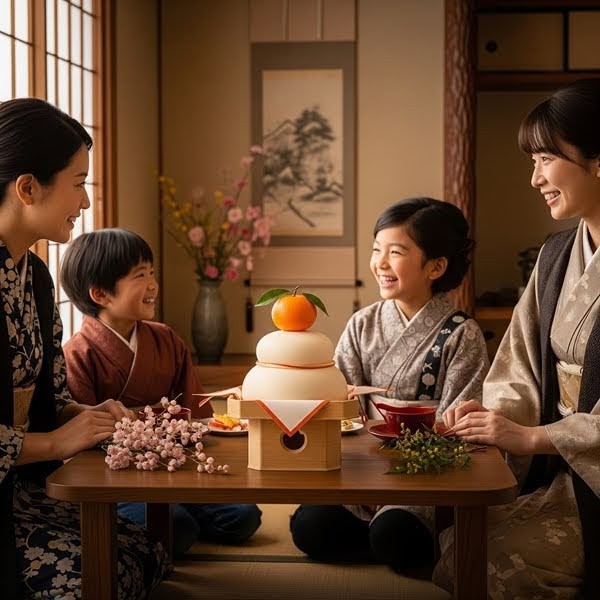
On this occasion, I would like to introduce a beautiful aspect of Japanese cultural heritage. Among Japan's many traditions, there is a special custom of stacking two round rice cakes, called "mochi," as a sacred decoration during the New Year. This traditional offering is known as "Kagami Mochi." Families place it in their homes to celebrate the beginning of the year and to welcome "Toshigami-sama," the deity of the New Year who brings blessings and renewal. While the practice of arranging Kagami Mochi is said to have originated during the Heian period over 1,000 years ago, the deeper custom of offering freshly harvested rice to express gratitude to spiritual beings dates back even further. Toshigami-sama represents a highly revered spiritual presence in Japanese folklore, and the Kagami Mochi embodies the heartfelt custom of welcoming the incoming year as a divine visitor.

This tradition serves as an invaluable bridge, passing down ancestral wisdom, culture, and values to the next generation. While we often use the phrase "passed down" lightly, centuries of parental devotion and cultural continuity are woven into this simple practice. The two stacked mochi cakes symbolize "heaven and earth" or the sacred relationship between "parents and children"—concepts of universal harmony found in cultures worldwide. Thus, Kagami Mochi is far more than a simple food item; it stands as a visual testament to family unity and domestic peace.

At the very top of the Kagami Mochi sits a small citrus fruit. In ancient Japan, this fruit was called "daidai." This custom arose because the word "daidai" is a homophone for the Japanese phrase meaning "from generation to generation," representing a prayer for the longevity and prosperity of the family lineage. When families gather to celebrate the New Year, the Kagami Mochi serves as a central symbol around which laughter and warm conversations are shared. Around January 11th, families gather once more to break and eat the mochi in a ritual called "Kagami Biraki." This event marks the official end of the New Year season and helps transition everyone smoothly back to daily life. During Kagami Biraki, tradition strictly forbids using knives or blades, as cutting the mochi is associated with "cutting" family ties; instead, the mochi is gently broken using a wooden mallet to preserve unity.

Today, I wanted to share with you the beauty of cherishing our cultural roots. In our temple, we will hold a traditional mochi-making event on December 30th and will have Kagami Mochi available for purchase. I warmly invite you all to decorate your homes with Kagami Mochi and welcome the coming year in the warm embrace of your family.

Rev. Josuke Inoue (釋 穣信)

Resident Minister, Honpa Hongwanji Mogi das Cruzes

Kaikyoshi — Jodo Shinshu Hongwanji-ha, South America District

↑ Back to index

The Meaning of Hoonko and the Nembutsu


The Meaning of Hoonko and the Nembutsu

Hoonko is the memorial service dedicated to Shinran Shonin, the founder of Jodo Shinshu. The term "Hoon" literally translates to "repaying our debt of gratitude." The invaluable gift that Shinran Shonin left behind for us to cherish is the core doctrine of Jodo Shinshu. While this is fundamentally rooted in Buddhist teachings, Buddhism itself is divided into various traditions. As you are well aware, the longstanding conflicts in the Middle East intensified dramatically last month. The divine figures in those monotheistic faiths do not explicitly promote war in their foundational scriptures. However, because their doctrines do not strictly forbid it either, and at times even suggest that one must fight to defend their faith, these beliefs often become catalysts for conflict. In monotheistic religions where the divine order is defined as the absolute "good," actions that do not align with this order are labeled as "evil," which can lead to armed efforts to correct or eliminate that perceived evil.

In contrast, Buddhism has never engaged in holy wars or religious crusades throughout its history. This is partly due to its inclusive nature as a tradition that actively respected and integrated local beliefs and customs. Furthermore, Buddhist teachings point to the fundamental reality of "emptiness" (Ku), guiding practitioners to transcend rigid, conventional notions of worldly order and absolute dogmas. What, then, is the core teaching of Buddhism? The ultimate goal is "Enlightenment," and the very word "Buddha" translates to "the awakened one." The realization of enlightenment is profoundly direct: understanding that all things are impermanent, all things are empty of an independent self, and all unawakened existence is suffering. Realizing these three marks of existence means aligning our lives with this reality. In this ultimate state, there is no absolute standard of good and evil; all such moral concepts are relative, existing only "from someone's perspective." This fundamental nature of reality is termed "emptiness." The goal of Buddhism is to liberate us from the diverse sufferings caused by clinging to personal judgments of good and bad, thereby allowing us to cultivate lasting inner peace.

Jodo Shinshu categorizes Buddhist paths into two primary approaches. The first is the path of self-power (Jiriki), where practitioners strive to reach enlightenment through their own strenuous efforts. This group includes various schools that require intensive study, strict monastic discipline, and the complete renunciation of worldly life, following the path of the historical Buddha, Siddhartha Gautama. The second approach, which includes Jodo Shinshu, relies on the other-power (Tariki) of Amida Buddha, who established a compassionate method to guide all beings to enlightenment. Historically, this path was revealed as a vehicle of universal salvation, especially for ordinary people who cannot leave their families and secular duties to become monks.

Honen Shonin, the founder of the Jodo sect, searched through thousands of volumes of Buddhist scriptures to find the practice of "Nembutsu," opening the gates of Buddhism—which had previously been reserved for monastics—to everyone. His foremost disciple, Shinran Shonin, wrote the "Kyogyoshinsho" to explain and validate the path of Nembutsu in a way that remains accessible yet profound. The "Shosingue," which we chanted together today, is a core section of this monumental work. Even though it was composed with a deep desire to be understood by all, its contents are spiritually vast and require sincere reflection to truly comprehend. Thanks to Shinran Shonin's tireless efforts, Buddhist salvation became universally accessible, establishing a rich 800-year history. Recognizing this profound legacy and expressing our deepest gratitude is the true purpose of Hoonko. And how do we repay this grace? We do so simply by reciting the Nembutsu with a heart full of gratitude.

Rev. Josuke Inoue (釋 穣信)

Resident Minister, Honpa Hongwanji Mogi das Cruzes

Kaikyoshi — Jodo Shinshu Hongwanji-ha, South America District

↑ Back to index

The Quality of Life and Our Ultimate Destination


The Quality of Life and Our Ultimate Destination

class="dropcap-paragraph">The changing of the seasons often brings various physical ailments. How do you deal with symptoms such as headaches, joint pain, fever, dizziness, nausea, stiff shoulders, or skin irritation? For physical pain, there are many over-the-counter medicines available that can temporarily relieve symptoms, and it is indeed practical to keep them at home. However, medical doctors will always recommend undergoing a proper examination to find and treat the root cause of the ailment. In Buddhism, we take the exact same fundamental approach to life's anxieties and worries: rather than relying on temporary distractions, we must address the root cause of our suffering.

Human anxieties can be broadly divided into two categories: those concerning health and finances, and those concerning the quality of life itself. While health and financial concerns do not apply equally to everyone, they represent areas where personal effort and diligence can often bring about positive changes. But what about the quality of life? What does "quality of life" actually mean? Is it determined by meeting wonderful people, or is it the accumulation of our achievements? There are many different perspectives on this matter.

By the way, do you feel that a year in childhood and a year in adulthood have the same length? Although they are objectively identical, many adults feel that a year passes by much faster. It is often said that as we age, a single year represents a smaller fraction of our lives lived so far, making it feel shorter. However, the true answer lies in the presence or absence of change. Spending our days in the same place, with the same people, doing the same things leaves us with fewer distinct memories, making the time seem to vanish. For instance, if you drive for ten hours on a routine route, how much of that journey will you remember later? But if you go on a ten-hour sightseeing trip and experience many new things, you will likely remember almost every detail of what you saw, where you went, and what you ate.

One day, every single one of us will look back upon our journey in our final moments. At that threshold, two things will be of vital importance. The first is being able to look back and say, "I have lived a truly good life." The second is having a clear spiritual destination. In our teachings, this destination is the Pure Land, the world of Amida Buddha. You have come here today to encounter the Buddha at this temple. Your family may have long-held traditions of conducting memorial services for your ancestors here, but do you know the true meaning of these rituals? They signify that when this present life ends, we will be born into the Pure Land of Amida Buddha. The core teaching of Jodo Shinshu is precisely to aspire for birth in this Pure Land. Therefore, everyone gathered here today will surely meet again in the world of Amida Buddha. The teaching of this temple is to make the promise that we will meet again.

Our talk today began with the quality of life. In the end, a life of true quality is one where, as we look back in our final moments, we find ourselves filled with gratitude for a journey rich with meaningful memories, while also holding a clear answer to the ultimate question: "Where am I going?" We express this profound aspiration to meet again in the Pure Land of Amida Buddha through the Nembutsu. Thank you very much. Namandabu.

Rev. Josuke Inoue (釋 穣信)

Resident Minister, Honpa Hongwanji Mogi das Cruzes

Kaikyoshi — Jodo Shinshu Hongwanji-ha, South America District

↑ Back to index

Obon: Remembrance, Gratitude, and Buddha's Healing


Obon: Remembrance, Gratitude, and Buddha's Healing

Good afternoon, everyone. Today, we gathered for the Japanese Obon, a Buddhist memorial service called "追悼法要" (Cerimônia de Lembrança / Memorial Service).

While memorial services of various kinds are held all over the world, today I would like to talk about the deeper meaning of this practice in Buddhism.

To describe the world we live in, we often use the word "宇宙" (Uchuu / Universe). The second character, "宙" (chuu), is frequently associated with the wide expanse of space, often read as "sora" (sky).

However, in a Chinese text from the Han dynasty nearly two thousand years ago, the "Huainanzi," it is written: "The infinite past and present represent Chuu (time); the four directions, above, and below represent U (space)." In other words, it was originally "U" that represented space and the sky. Interestingly, over time, people began to misunderstand "Chuu" as representing physical space. While common language shifts and accepts new meanings over time, understanding the precise, original meaning remains important.

Today, when we think of the "universe," we primarily envision the vast physical space containing stars and galaxies. Yet, in ancient times, human beings perceived the world as a unified integration of time and space. They did not view their existence solely from the perspective of the immediate "now"—isolated between the past and the future—but rather saw themselves as a passing point in a grand continuum. Because of this, they deeply valued their ancestors as their starting point, and cherished "family" as the bridge to future generations. Although our individual lives are finite and eventually end, a family lineage continues through generations as a single, enduring entity. In this sense, a memorial service is not just about the living mourning the deceased; it is a profound act of paying respect to the nature of our world as active participants in history.

Now, let us trace back to the origin of Obon, which many of you may already know.

Among the disciples of Shakyamuni Buddha was Mokuren (Maudgalyayana). He possessed supernatural powers that allowed him to see beyond time and space, yet he turned to the Buddhist path because he could not perceive the ultimate truth (Enlightenment) on his own.

One day, when searching for his deceased mother, he saw her suffering in the realm of hungry ghosts—a state of constant torment driven by insatiable greed and desire, where no satisfaction could ever be found.

Grieved by this sight, Mokuren asked the Buddha why his mother was in such a state and how he could save her. The Buddha explained that she fell into the realm of hungry ghosts because, during her lifetime, she was so obsessively worried about providing for you, her child, that she relentlessly hoarded food. In times of scarcity, hoarding food meant monopolizing resources that belonged to others, which severely disrupted the natural harmony of sharing equally.

To save her, the Buddha instructed Mokuren to make food offerings to others, demonstrating the act of letting go of material attachments and sharing with the community. It is said that through this meritorious act, his mother was liberated and attained Nirvana.

Although this story was originally meant to warn against greed and hoarding, the child's deep love and remembrance for the deceased mother eventually evolved into the traditional custom of honoring and memorializing the deceased.

In Japanese, the word "追悼" (tsuito / remembrance) generally means to grieve someone's passing while reflecting on their life. The core of this feeling is often characterized by a strong sense of pity or sorrow for the deceased. However, is it not somewhat presumptuous to draw a rigid line between the living and the dead, and unilaterally pity those who have passed away?

Certainly, for those of us who are alive, nothing is more precious than life itself, and being alive is indeed a vital reality. But can we say that simply being alive guarantees happiness? That is a difficult question. At last month's Young Buddhist Association conference, the dialogue between the guest minister and the young participants centered heavily on "what we can gain from Buddhism to live a better life."

This is a natural question for young people with promising futures. Yet, even in living, we carry many worries and sufferings. There are times in life when the burden feels so heavy that some even wish to end it, and unfortunately, suicide remains a significant cause of death.

It is difficult to separate our act of remembrance from the feeling of pity. However, we must sincerely confront the true nature of this pity.

The true target of our pity is not actually the life that was lost. Rather, it is the profound sense of loneliness that we, the living, feel because we have lost someone dear to us.

In other words, the one who is truly pitiable is "myself," the one experiencing the grief and sadness.

The depth of our sorrow is a direct reflection of the immense happiness and love we received from them. Thus, our remembrance naturally transforms into a profound sense of gratitude. Memorializing the deceased is not just about pitying and reaching out to them; it is about finding comfort and healing within ourselves as we recall their warm presence in our hearts. As we see in Mokuren's story, remembering his mother ultimately brought him healing. In Buddhism, we call those who continue to heal others even after their death "Buddhas."

Obon is a day to receive the healing light of Buddha within ourselves. Living with a heart full of deep gratitude for every encounter and for existence itself means walking alongside Buddha. It serves as our guiding light toward a truly fulfilling life.

Rev. Josuke Inoue (釋 穣信)

Resident Minister, Honpa Hongwanji Mogi das Cruzes

Kaikyoshi — Jodo Shinshu Hongwanji-ha, South America District

↑ Back to index

Being Born Human and Living Humanely


Being Born Human and Living Humanely

Good afternoon, everyone. Today, we hold this memorial service to commemorate the temple’s new beginning in this location. Therefore, I would like to reflect on what it means to be born as a human being.

Our lives are born into this world without us knowing. I believe no one is born wishing to be a human. The body comes first, and traits like personality and knowledge are acquired afterward. Specifically, it is said that about 30% of a person’s abilities and personality are determined by genetics, while the remaining 70% are shaped by the environment and interactions. This includes education and the living environment.

This is easily understood through the story of a child raised by animals. In the past, a boy raised by wolves was found in India. From birth, he was taken by a wolf and raised among them. When he was brought back to human society, he could not stop walking on all fours or communicate other than through wolf howls. Genetically, he was human, but "wolf habits" were incorporated into that remaining 70%. Conversely, I have never heard of a dog raised from birth by humans walking on two legs and using words. This means that depending on how we are raised, we can become either human or beast. To become a human, one must be born as a person and establish relationships with others.

So, what does it mean to live as a human? There is an expression: "A dog rarely does anything that is not dog-like, while humans often do things that are not human-like. When an ant finds something sweet, it always takes it to the nest, while humans secretly try to eat it alone." This is thought-provoking. What is "human-like"? For example, if you lick your plate at dinner, you are scolded for acting like a dog. Does using chopsticks, knives, or forks make one more human? There are many countries where people eat only with their hands. "Secretly eating something sweet alone" might actually be the most human behavior. It is living according to selfish desires, putting oneself first. Yet, we do not call this "human." We call it "cunning." Perhaps what we feel when we say someone is living as a human is knowing what "shame" is.

If we speak of the essence of humanity, I think it is the selfish desire to satisfy our own cravings and wanting only the best for ourselves. At the same time, we know that living purely by desire is shameful. Therefore, we suppress our desires and live considering others. This is why we feel someone is "living as a human." In Buddhism, this sense of shame is called "Zanki." Shinran Shonin divided Zanki into three parts: 1. Not committing sins oneself and not making others commit them. 2. Having shame within oneself and revealing it to others. 3. Feeling ashamed before the world and before Buddha. Those who possess this sense of shame are called "humans," while those who lack it are called "animals." In other words, we can only become "human" to a certain extent through our own efforts.

There is a saying: "Born by humans, we become human; desired by Buddha, we become Buddha." Our lives are desired by Buddha Amida so that we may become Buddhas. And Amida Buddha has transmitted all his vows, work, and merit to us through the recitation of the Nembutsu ("Namu Amida Butsu"). To listen to the Dharma means we are being raised by Amida Buddha. Joining our hands means we have a place to reflect on our own state. It is difficult for people to reflect on themselves in front of others. A marital quarrel is a good example; even when we know we are wrong, it is hard to apologize sincerely. Yet, for some reason, when we sit before Buddha, we can honestly reflect on ourselves. We can see our own image clearly—how we shift blame onto others. Having time in our lives to join our hands before Buddha is having time to reflect on the self. Self-reflection is not just repentance; it is reflecting on everything—the good, the bad, the happy, and the sad.

Though we are busy with work, study, and play, let us make time to join our hands before Buddha in our daily lives.

Rev. Josuke Inoue (釋 穣信)

Resident Minister, Honpa Hongwanji Mogi das Cruzes

Kaikyoshi — Jodo Shinshu Hongwanji-ha, South America District

↑ Back to index

June 2023 - Tribute to Immigrants and the Lesson of the Carp


June 2023 - Tribute to Immigrants and the Lesson of the Carp

Good afternoon, everyone. First, I would like to offer a memorial greeting for the 115th anniversary of Japanese immigration to Brazil.

Today, at this memorial service for immigrants: "A Gathering to Remember the Japanese Who Migrated to Brazil," we pay tribute to those who, with courage and determination, left their distant homeland to build a new life in this country and faced an unknown world. We honor our ancestors by learning from their achievements and passing them on to future generations. May we nurture the seeds they left in our hearts—humility, patience, diligence, and cooperation—to build a bright future for the next generation. We express our deepest gratitude.

Now, I would like to share a story about the teachings of the Jodo Shinshu school.

Today, I will introduce a story from Rev. Tokunaga, former Head of the Kangaku-ryo (School of Buddhist Studies) of the Jodo Shinshu Honganji-ha. The Kangaku-ryo is an institution that evaluates whether the writings of the Head Priest are doctrinally correct and gathers the most respected scholars within the sect.

Some may think that lectures by such a teacher are very difficult, but Rev. Tokunaga's stories are always gentle, clear, and wonderful. Let me introduce this story, which took place at Rev. Tokunaga's home.

In the garden of his home in Kyoto, there is a pond with about twenty koi carp. Every year in early summer, the koi lay many eggs, but most of them are eaten as eggs or fry. By autumn, only two or three appear from the shadows of the rocks or plants. It is truly sad to think that most of the hundreds or thousands born are devoured.

Therefore, this year, I scooped up the palm fibers where the eggs were laid and moved them to another tank. I was nervous that the change in environment might kill them all. However, a few nights later, when I looked into the tank with a flashlight, I was astonished. Instead of perishing, hundreds of two-millimeter-long fry had hatched. I was overwhelmed by the mystery of life nurtured by nature.

After a while, the fry grew too large for that tank, but they could not be released back into the original pond yet; they would be eaten by the adult fish immediately. So, I released them into a large plastic pond a few days ago. They are growing at different rates, but for now, they are all swimming healthily.

What I want to say here is not that I saved the lives of hundreds of fry that would have otherwise disappeared. My current thought is the opposite: that perhaps I did something unnecessary. If I were to wait until they were large enough to return to the original pond, the ecosystem of the pond would be destroyed in an instant because of the hundreds of new koi. Introducing hundreds of fish to the existing twenty would likely lead to the demise of everyone, including the original fish.

My good intention to save the lives of the fry that would have surely disappeared has now created a problem that could lead to collapse. Perhaps my action, which I believed to be well-intentioned, was merely a fragile humanism when viewed under the laws of nature.

In short, the affection I felt for the fry was one-sided, and I did not realize that it was accompanied by a shadow. The laws of nature are also at work in my garden pond, and my action, however well-intentioned, ignored those natural laws.

Through this experience, I grasped the true intention of Shinran Shonin, who showed us that our shallow calculations, which add our own thoughts to the mysterious working of the Primal Vow, are invalid.

I believe the Shonin admonished us that whether we think we cannot be saved or that we will be fine because we have listened to the Nembutsu, our selfish calculations are always accompanied by shadows. Beyond any gain or loss I can imagine, the Great Compassion of the Primal Vow reaches me with a light without shadows—that is, a light without calculations.

The teacher shared this story to show that even when we think our actions are good, they are not necessarily "good from every perspective." The fundamental philosophy of Buddhism is to look at things objectively from all perspectives to understand their true nature. This is why the founder, Shakyamuni Buddha, left so many teachings in the sutras. In Jodo Shinshu, we value understanding the essence of things through the life of our founder, Shinran Shonin. There is the "principle of cause and effect," where we calmly observe that every result has a cause.

In other words, we do not rely on groundless prayers or fortune-telling. Furthermore, we do not attribute our conveniences or inconveniences to gods or spirits. Living in harmony with the reality of the world as it is, based on these principles, is the spirit of Jodo Shinshu and the "pride of the Monto" (disciples) that your ancestors have passed down through generations to this land of South America. I hope that sharing this story will be an opportunity for us living in modern society to reflect on various things.

By the way, what happened to the koi in this story? When I met Rev. Tokunaga personally, I asked, "Do you have any questions?" Although it was unrelated to the lecture, I asked him. He told me they were released into the Kamo River in the city at night. I do not know if it was right or wrong. If it was wrong, it means the sect is responsible for affecting the Kyoto ecosystem, so please keep it a secret. I will end my sermon here.

Rev. Josuke Inoue (釋 穣信)

Resident Minister, Honpa Hongwanji Mogi das Cruzes

Kaikyoshi — Jodo Shinshu Hongwanji-ha, South America District

↑ Back to index


Contato
Templo Honpa Hongwanji de Mogi das Cruzes
    
Rua Padre Albino Bareta, 01 - Parque das Varinhas
Mog das Cruzes, SP - Brasil
CEP08753-340
Tel:(11)4799-0530

47654975000105

Source / 思想ソース